What Is a HELOC and How Does It Work?
A HELOC lets homeowners borrow against available home equity. Learn how it works, common uses, repayment basics, and key risks.
In this guide (6 sections)
A common question among homeowners is what is a HELOC and how it differs from other ways to borrow. A HELOC, short for home equity line of credit, is a revolving credit line secured by a home. Instead of receiving one lump sum at closing, borrowers generally get access to a credit line that can be used over time, up to an approved limit. Because the home serves as collateral, lenders closely review equity, income, credit history, and existing debt before making a decision.
What a HELOC is
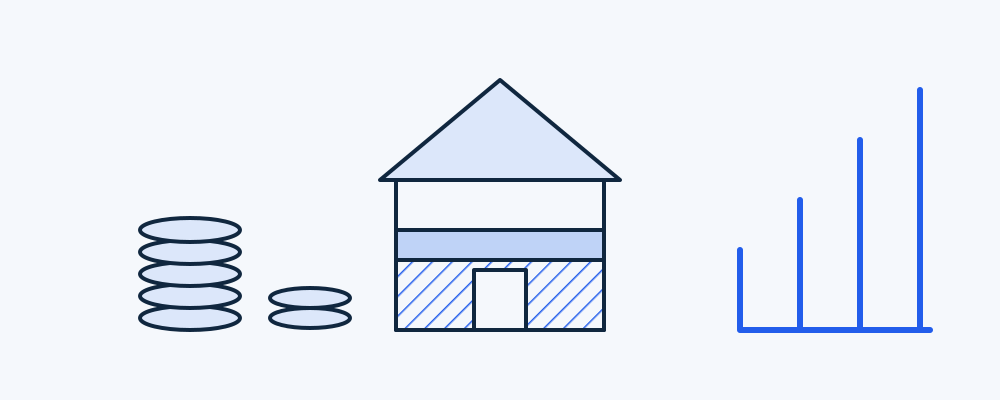
A HELOC is a form of home equity borrowing that works more like a credit card than a traditional mortgage. The lender establishes a maximum credit limit based partly on the home's value and the amount still owed on the primary mortgage. The difference between the home's value and the mortgage balance is often called home equity.
Revolving access to funds
With a HELOC, money can usually be borrowed as needed during an initial draw period. That structure makes it different from a standard home equity loan, which often provides a single disbursement upfront. Borrowers may draw smaller amounts for different expenses over time rather than taking the full amount at once.
Common features often include:
- A set credit limit
- A draw period, when funds may be accessed
- A repayment period, when the balance is paid back
- Variable borrowing costs in many cases
- A lien secured by the home
Why homeowners consider it
HELOCs are often discussed when homeowners want flexibility. A line of credit can be useful for costs that arrive in stages, such as remodeling projects, ongoing repairs, or education expenses spread across multiple terms. Some borrowers also compare a HELOC with cash-out refinancing or a closed-end home equity loan when evaluating ways to access equity.
How a HELOC works
The basic structure of a HELOC centers on two phases, the draw period and the repayment period. The exact terms can vary by lender, but the overall concept is similar across the market.
The draw period
During the draw period, funds may be borrowed, repaid, and borrowed again, as long as the outstanding balance stays within the approved limit. This revolving feature is one of the main reasons people ask what a HELOC is instead of simply calling it a second mortgage.
Access to funds may happen through:
- Online transfers
- Special checks tied to the credit line
- A card linked to the account
- Branch or phone requests, depending on the lender
Some HELOCs allow interest-only payments during the draw period, while others may require payments toward both principal and interest. The payment structure depends on the lender's terms and the amount borrowed.
The repayment period
After the draw period ends, the line usually enters repayment. At that point, new draws are commonly no longer allowed, and the remaining balance is repaid over a set period. Because borrowing access has ended, monthly payments may change, sometimes noticeably, depending on the balance and the loan terms.
Variable costs and payment changes
Many HELOCs have variable rates tied to a benchmark, which means borrowing costs can move up or down over time. That can affect monthly payments and the total cost of borrowing. Some products may include rate caps, floor features, or conversion options for part of the balance, but these details vary and are not universal.
For homeowners comparing options, tools like a HELOC calculator and other resources on the home equity page can help frame the numbers before speaking with a loan officer.
How lenders decide the credit line
A HELOC approval is not based on equity alone. Lenders generally review the property's value, the current mortgage balance, financial stability, and overall risk.
Home equity and combined loan balance
The amount available through a HELOC is often influenced by how much equity exists in the home and how much total mortgage debt the lender is comfortable allowing against the property. This combined figure may include the first mortgage plus the HELOC limit or the amount expected to be drawn.
If home values have increased over time, available equity may be higher than expected. If values have fallen, borrowing capacity may be more limited.
Income, debt, and credit profile
Lenders also review whether the borrower appears able to manage the payment. That often includes checking:
- Income and employment history
- Existing monthly debt obligations
- Credit history and overall credit profile
- Cash reserves in some cases
- Property type and occupancy status
A stronger financial profile may support better terms, but every lender has its own underwriting standards.
Appraisal and documentation
Some HELOC applications involve a full appraisal, while others rely on alternative valuation methods. Documentation often includes proof of income, mortgage statements, homeowners insurance information, and identity verification. If the property is held jointly, additional signatures or documents may be required.
Common uses for a HELOC
Because a HELOC is flexible, homeowners often consider it for expenses that are large, uneven, or ongoing. Still, the best use case depends on goals, risk tolerance, and how long repayment may take.
Home improvements and repairs
One of the most common reasons to explore a HELOC is funding home updates. Projects such as kitchen renovations, roof replacement, HVAC work, or accessibility upgrades may unfold over time, making a revolving line practical.
That said, not every renovation adds value in the same way. Some projects are more about comfort and function than resale return, so homeowners often weigh the borrowing cost against the long-term benefit.
Emergency expenses and financial flexibility
Some households consider a HELOC as a back-up source of funds for major unexpected expenses. Others use it to manage large bills that cannot easily be covered from savings alone. The appeal often comes from keeping the line available and drawing only what is needed.
Debt consolidation, with caution
A HELOC is sometimes used to consolidate other debts. While that can simplify payments, it also shifts unsecured debt into debt secured by the home. That change raises the stakes because missed payments on a HELOC may place the property at risk. For that reason, many homeowners look closely at spending habits and repayment plans before using home equity this way.
HELOC pros, risks, and alternatives
Understanding the tradeoffs is essential when asking what is a HELOC. The flexibility can be useful, but the product is not risk-free.
Potential advantages
A HELOC may offer several benefits, depending on the situation:
- Funds can be used as needed instead of taken all at once
- Interest may apply only to the amount borrowed
- It can support staged expenses like remodeling
- Existing mortgage terms may remain unchanged, unlike a refinance
For some homeowners, keeping the first mortgage in place is a major reason to compare a HELOC with a cash-out refinance.
Important risks
The main risks deserve equal attention:
- The home secures the line of credit
- Payments may rise if variable costs increase
- Monthly obligations may jump when repayment begins
- Easy access to funds can lead to overborrowing
- Property values can change over time
A HELOC can be helpful when managed carefully, but it can create strain if the balance grows without a clear repayment plan.
Alternatives to compare
Homeowners often compare a HELOC with:
- A home equity loan, which usually provides a lump sum
- A cash-out refinance, which replaces the current mortgage
- Personal loans, which are generally unsecured
- Savings or phased project spending
Each option has different tradeoffs around flexibility, payment stability, closing costs, and how the debt is secured. A broader overview of mortgage products is available on the loans page, and payment scenarios can be explored with the mortgage payment calculator.
What to know before moving forward
The question what is a HELOC often starts with curiosity about tapping home equity, but the bigger issue is fit. A HELOC is best understood as a secured revolving credit line with changing costs, defined borrowing limits, and repayment obligations that can shift over time.
Key questions homeowners often weigh
Before applying, many people spend time considering:
- How much equity is available
- Whether the expense is one-time or ongoing
- How variable payments could affect the budget
- Whether the home may be sold in the near future
- How the repayment period might change monthly costs
Why timing and goals matter
A HELOC can make more sense in some situations than others. For example, it may fit better when expenses happen in phases, when the current first mortgage is worth keeping, or when flexibility matters more than a one-time disbursement. In other cases, a fixed loan or another financing method may be easier to manage.
Borrowers often benefit from reviewing estimates, lender disclosures, and repayment mechanics carefully so the structure is clear before any line is opened. Educational resources from the Consumer Financial Protection Bureau and HUD can also help explain home equity borrowing and the broader home finance process.
For homeowners exploring next steps, Mortgage Today offers educational tools and a contact form that can connect readers with a loan officer in our network.
Frequently asked questions
What is a HELOC in simple terms?
Is a HELOC the same as a home equity loan?
What can a HELOC be used for?
Does a HELOC affect the first mortgage?
Mortgage Today is owned and operated by Mektra LLC.
Mortgage Today is an educational brand and does not originate, broker, or fund loans of any kind. When you submit a request, we forward your information to a licensed loan officer in our network.
Was this helpful?
Was this helpful?
Not sure what you should do next?
Every situation is different. Get a clear, neutral walk-through of your options based on your numbers, timeline, and goals.
This is not a loan approval or commitment to lend. All scenarios are subject to review and qualification.
The Mortgage Today Brief
Optional and free mortgage education by email. No account required.
Mortgage Today is an independent mortgage education brand owned by Mektra LLC. We do not originate loans; inquiries are forwarded to a licensed loan officer in our network.
Learn more about Mortgage Today